

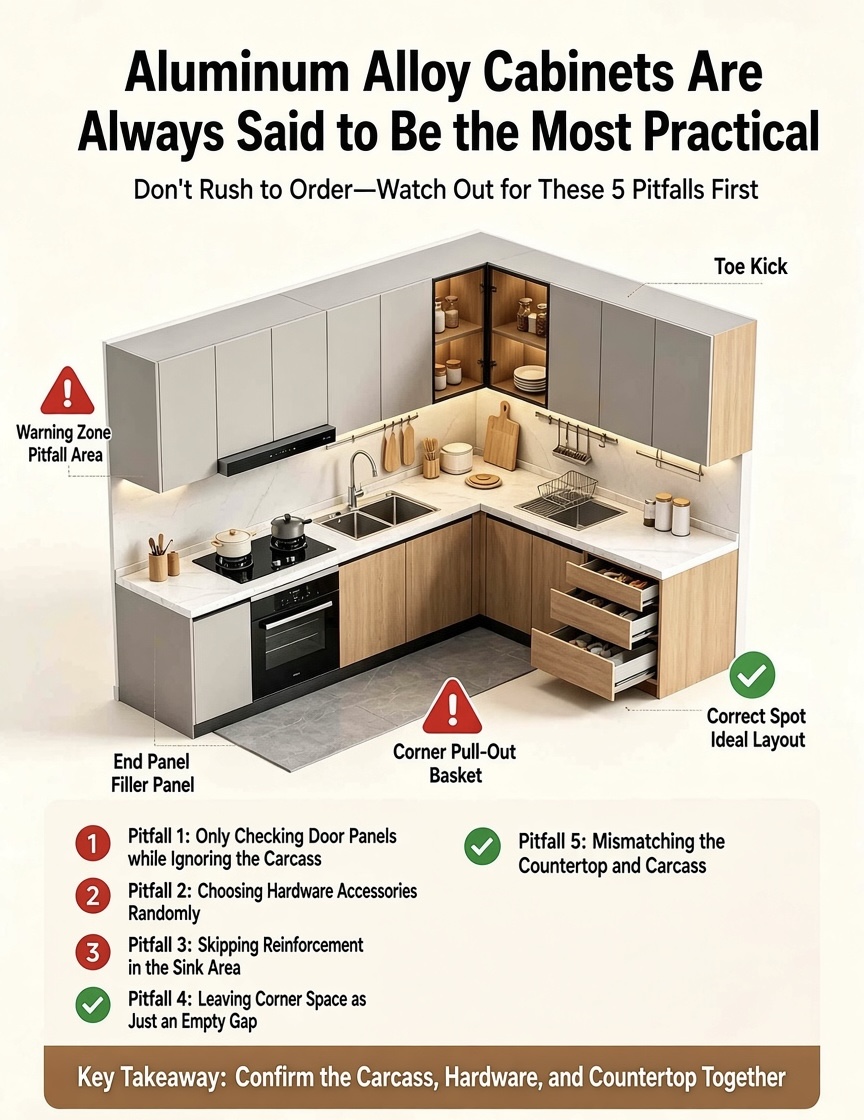
Because aluminum alloy cabinets are moisture-proof, scratch-resistant, and easy to clean, many people consider them ideal for the kitchen.
However, choosing aluminum doesn't automatically guarantee durability. What truly determines the long-term user experience comes down to the carcass, hardware, countertop, sink area, and storage details.
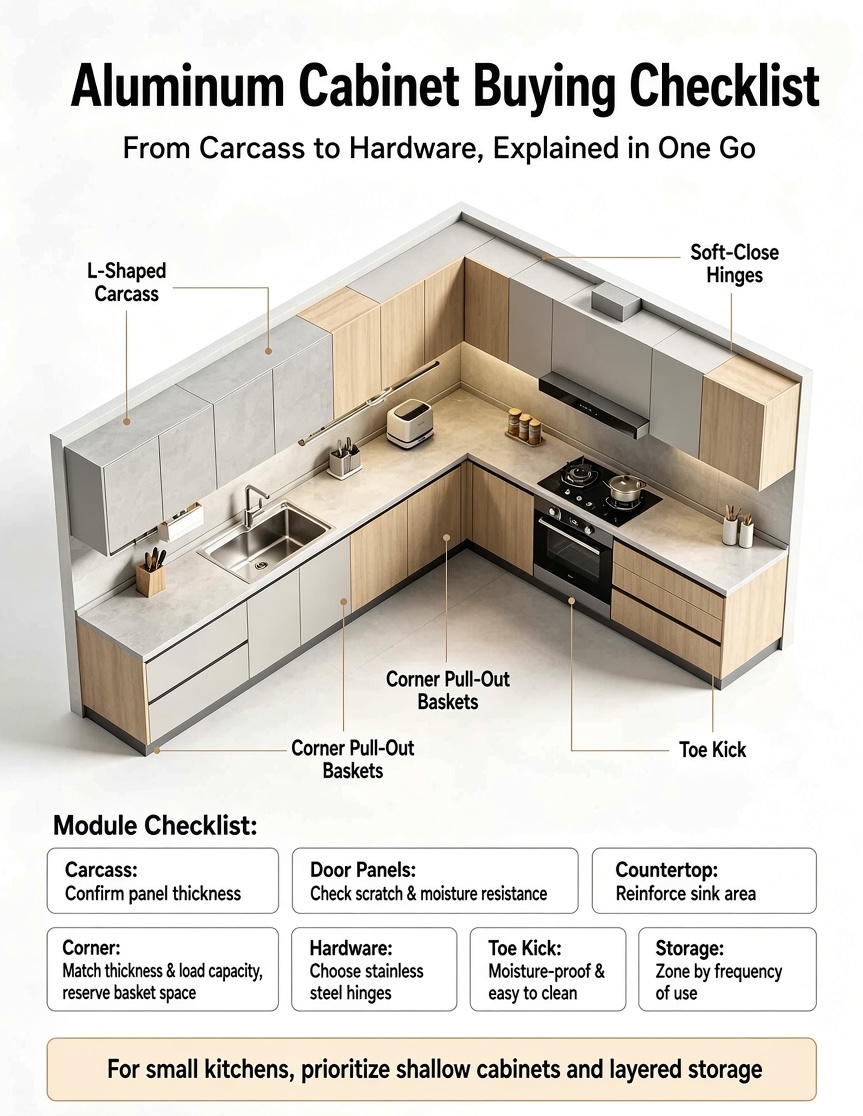
5 Key Points to Focus On When Choosing Aluminum Cabinets:
01 | Don't Just Look at Door Panels; the Carcass Matters More
When choosing cabinets, many people only focus on the door panel colors and styles while ignoring the carcass structure.
If the carcass is too thin or lacks sufficient support, issues like shaking, deformation, and uneven countertop weight distribution can easily occur over time.
When making a purchase, confirm the carcass thickness, frame structure, and load-bearing capacity first.
02 | Don't Settle for Low-Quality Hardware
How functional a cabinet is depends heavily on its hardware.
Hinges, drawer slides, and pull-out basket accessories are opened and closed repeatedly every day; if the quality is poor, they can easily become loose, noisy, or rusty.
Because the kitchen is humid and oily, it is recommended to prioritize stainless steel or rust-resistant materials for hardware.
03 | The Sink Area Must Be Reinforced
The sink area is one of the most moisture-prone and heavily loaded zones in the kitchen.
If only a standard carcass is used, problems such as countertop sagging, carcass moisture damage, and door warping may develop over time.
It is advised to focus on reinforcing the sink area—confirming countertop thickness, carcass support, and waterproofing treatments together.
04 | Don't Leave Corner Spaces as Empty Gaps
Many kitchens feature L-shaped or U-shaped layouts, but if the corner space is left as just a large empty gap, it becomes inconvenient to use.
Pots and odds and ends stored inside are hard to reach, often making it a "forgotten corner."
Plan corner pull-out baskets, tiered storage, or magic corner organizers in advance to maximize space utilization.
05 | Ensure the Countertop and Carcass Are Properly Matched
When choosing a countertop, don't focus solely on aesthetics.
Countertops of different thicknesses require different levels of support from the carcass—especially quartz, sintered stone, and stainless steel countertops, which vary in weight capacity and installation methods.
It is best to confirm the countertop, carcass, sink, and cooktop placement together to avoid issues with cutouts, seam joining, and load-bearing capacity later on.
Aluminum alloy cabinets certainly offer many advantages, but they are not a one-size-fits-all answer that you can choose blindly without consequence.
A truly durable kitchen cabinet does not depend solely on the material name, but rather on the carcass structure, hardware quality, sink reinforcement, storage design, and installation details.
Confirm these key points clearly first before focusing on colors and styles—that is the surest way to avoid buyer's remorse.