
When homeowners, villa developers, and property managers first evaluate interior furnishings, their initial reaction is often the same: "Isn't all-aluminum furniture more expensive than solid wood or MDF?"
However, focusing solely on the upfront price tag is a critical financial miscalculation. In high-stakes real estate markets—especially across Africa’s luxury coastal resorts, safari lodges, and high-end urban apartments—the upfront purchase price is only a fraction of the total cost. When factoring in rapid atmospheric degradation, endless maintenance, replacement cycles, and disposal fees, traditional timber and engineered boards quickly become the most expensive mistake a property owner can make.
1. The African Climate Crucible: Accelerated Destruction of Timber & MDF
Africa’s diverse and extreme climate zones present a brutal proving ground for building materials:
Coastal Salt Fog & High Humidity: In coastal hubs like Mombasa, Lagos, Zanzibar, and Cape Town, moisture and salt spray penetrate wood pores overnight. MDF and particleboards act like sponges, causing edge-banding glues to dissolve and panels to swell into useless mush within 12 to 24 months.
Extreme Thermal Cycles & UV Radiation: From the intense sun of Sub-Saharan regions to high-desert temperature swings, lacquers crack, clear coats peel, and real timber splits along natural grain lines due to rapid expansion and contraction.
Aggressive Termite Swarms & Fungi: Subterranean termites and tropical rot fungi thrive in humid, warm conditions. Solid timber and plywood cabinet boxes are frequently hollowed out from the inside before owners even notice structural failure.
For luxury rental villas and premium managed apartments, a rotted kitchen cabinet or termite-infested wardrobe translates directly into guest complaints, lost rental revenue, and emergency repair bills.
2. Lifetime Cost & Usability Comparison Matrix
When analyzing long-term return on investment (ROI), the true value of 6063-T5 aluminum alloy becomes overwhelmingly clear:
| Cost & Operational Metric | All-Aluminum Furniture (3-in-1 System) | Premium Solid Wood | Engineered Wood (MDF / Particle Board) |
| Initial Upfront Investment | Moderate to High | High to Very High | Low to Moderate |
| Lifespan in Extreme African Climates | 50+ Years (Zero structural degradation) | 3–7 Years (Requires continuous restoration) | 1–3 Years (Rapid swelling & destruction) |
| Ongoing Maintenance & Refinishing Costs | $0 (Simply wipe down with water) | High (Periodic sanding, oiling, termite treatments) | Impossile to maintain; swelling cannot be repaired |
| Relocation & Re-assembly Flexibility | 100% Reusable (3-in-1 Quick-Lock System); easy disassembly without damaging profiles | Low (Screw holes strip after 1–2 disassemblies; wood cracks) | Zero (Single-Use); breaks down upon disassembly |
| Disposal & Disposal Fee Impact | Zero Cost; zero bulky waste left on site | High handling costs; heavy bulky disposal | High disposal fees; chemical-laden waste requires burning/landfill |
| End-of-Life Residual Value | High Metal Scrap Recovery Value (Aluminum retains intrinsic material worth) | Zero financial return (Burnt or rotted waste) | Zero financial return (Negative value due to disposal fees) |
3. The Game-Changer: 3-in-1 Modular Knockdown & Relocation
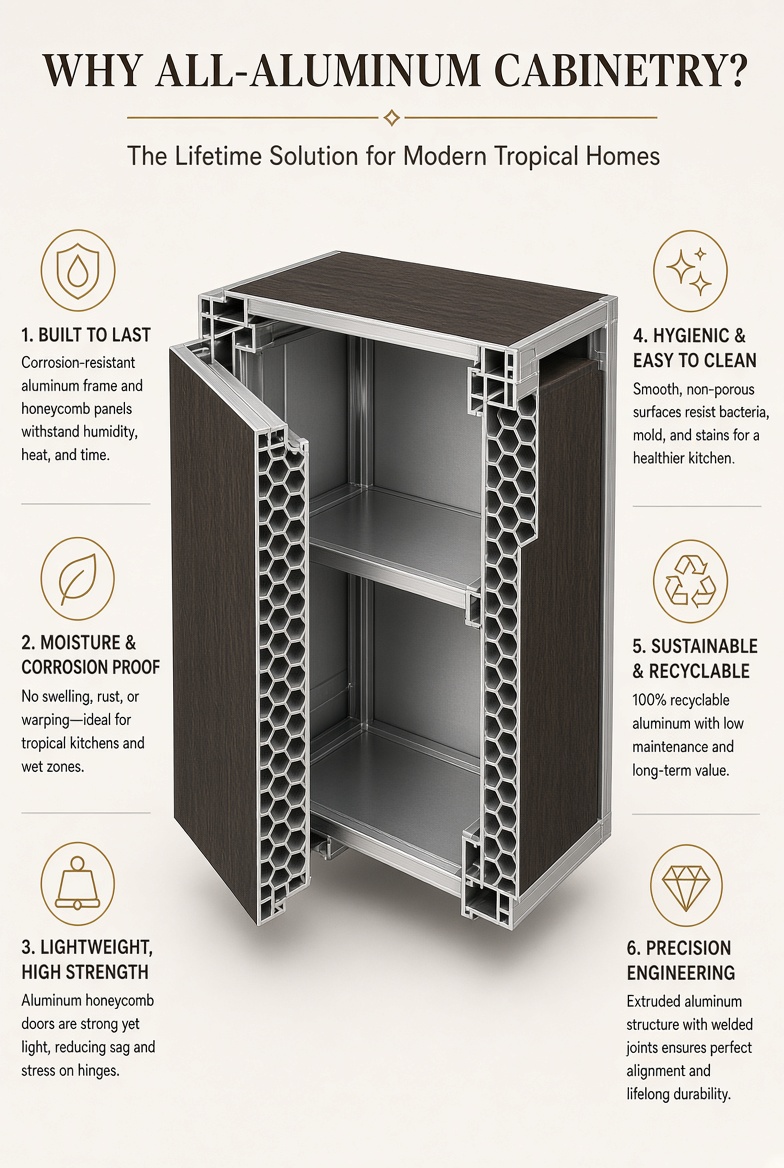
The most devastating feature of modern aluminum cabinetry over traditional materials is its 3-in-1 Structural Knockdown Engineering.
Unlike MDF or wood cabinetry—which relies on permanent glue, nails, or expansion dowels that tear apart particleboard cores when uninstalled—our precision aluminum system uses reusable, heavy-duty mechanical locking fasteners.
Dismantle & Re-assemble Anywhere: If you renovate, move apartments, or reconfigure a villa layout, aluminum cabinets can be completely taken apart, moved, and rebuilt without losing a single millimeter of structural integrity or stripping a screw thread.
Eliminate Waste & Landfill Charges: Traditional built-ins must be smashed with sledgehammers, creating costly trash removal burdens. Aluminum cabinetry remains a flexible, movable architectural asset.
4. Question & Answer (Q&A)
Q: Is all-aluminum furniture really worth the higher initial price compared to MDF or solid wood in Africa?
A: Yes. While aluminum may carry a higher upfront cost than MDF or local timber, it completely eliminates recurring expenses such as sanding, re-staining, chemical termite sprays, and premature replacements. Over a 10-year period, aluminum cabinetry costs up to 60% less in total ownership costs while maintaining a brand-new appearance.
Q: What happens to solid wood and MDF kitchen cabinets in humid or coastal African climates?
A: MDF and particleboards absorb ambient atmospheric moisture, leading to severe edge-banding failure, swollen door panels, and toxic mold growth within 1 to 3 years. Solid wood frequently splits, warps, and falls victim to subterranean termites, requiring total replacement and expensive disposal.
Q: Can all-aluminum cabinetry be re-used if I move or remodel my home?
A: Absolutely. Utilizing a modern 3-in-1 modular joint system, all-aluminum cabinets can be disassembled and re-assembled infinitely without damaging the panel structure or losing mechanical strength. Wooden and MDF furniture, by contrast, are single-use installations that tear apart upon removal.
Q: Does aluminum furniture hold any resale or scrap value at the end of its life?
A: Yes. Unlike wood, MDF, or plastic laminate that turns into worthless, tax-dappled trash, aluminum is a highly sought-after commercial metal. Even after decades of heavy use, aluminum profiles retain intrinsic scrap metal value, ensuring your furniture remains a financial asset rather than a disposal liability.